Monday, June 27, 2016

Sleep

Its never been a problem for me.  In fact my sleeping prowess is pretty legendary among my family.  However this is not the case for many people and the more I learn about health and wellness the more convinced I've become that sleep might be one of the most overlooked aspects of maintaining proper health.  I think diet is still the number one factor but that is closely followed by sleep.  Yes ahead of exercise.  Why is sleep so important?  Well 2 functions of sleep are
  1. your brain cleans up cellular garbage when you sleep
  2. your body repairs itself while you sleep
If you aren't getting this nightly clean up it can manifest itself in some of the following problems.
  1. a decline in immune function
  2. an increase in cortisol, catecholamines, and other stress hormones
  3. imbalances in appetite and blood sugar regulating hormones
  4. increased levels of inflammatory hormones such as interleukin and C-reactive protein
  5. Testosterone and thyroid hormones
  6. lower will power
Just to name a few

Still aren't convinced, check out this TED talk by Dr Doc Parsley.  He discovered the importance of sleep working with Navy Seals.  Nearly all of them had broken sleep patterns and were using sleep aids to help them sleep.


Or perhaps these low performing athletes


“sleep is extremely important to me – I need to rest and recover in order for the training I do to be absorbed by my body.”


  “If I don’t sleep 11 to 12 hours a day, it’s not right.” 

Gareth Bale, yeah you know that guy that is crushing it for Wales in the euro cup at the time of this writing.  He and Real Madrid hired sleep expert Nick Littlehales to help the team.

How Gareth Bale and Real Madrid sleep their way to the top

Ok we get it, sleep is important.  What can I do to sleep better?  Below are all the tools, tips and tricks I have accumulated in no particular order.

1) Avoid blue light in the evenings.  Blue light from TV screens, computer screens, phones, lights around the bathroom mirror etc late in the evening will disrupt your circadian rhythm and block your natural release of melatonin at night which makes you tired.  So either go tech free an hour before bed or alternatively this is what I do, I put on glasses that block blue light around 8-9 pm.  Yes I look like a complete idiot.

I use these cheap $9 safety specs and yes these do really work, you will get tired watching that evening movie or show.


Want something that looks a little cooler, you could spend a bit more and get these.


Or perhaps these, designed for gamers.

Apple obviously thought this was enough of an issue to include it as a new feature in IOS 9.3.  You can now get Night Shift which changes the amount of blue light on the screen depending on the time of the day.  It gives it an orange hue to it.  It only works on iphone 5s or higher and certain ipads.


For your computer screen and some other devices you can install the free utility f.lux.  Below it shows how much light is blocked for a Macbook Air with f.lux turned on.


Or perhaps you don't want to wear some silly glasses and you have a tv in your bedroom.  You can now buy a device that your tv plugs into that will filter the blue light for you depending on the time of the day or whatever schedule you set.  I've bought one of these for the tv in our bedroom as my wife likes to watch tv before bed.  We just moved and its not hooked up yet but I'll give a full report once we start using it.


2)   Make your sleeping room absolutely pitch black, no lights of any kind.  My wife watches tv so I wear a sleep mask and ear plugs.  I use this sleep master mask.  


3)  Keep the room cold 68 deg or lower.  If one of you is hot (normally the woman) and the other cold.  You could try one of these cooling mats for the woman.  They are pretty pricey $450 but some people swear by them. 


4)  Don’t drink alcohol close to bedtime.  More than two glasses of wine within four hours of sleep decreases deep-wave sleep 20–50%. Even four glasses six hours beforehand did not appear to have this effect, so the timing is crucial.


5)  Caffeine.  This can vary widely from person to person but as a general rule I don't drink any after 12 pm, except the occasional spot of tea of course.  The half life of caffeine can vary widely depending on the person based on genetics and other factors.  I'm sure you know that person that can drink coffee right before bed and sleep like a log, it is likely partially due to genes.  Here is my DNA Fit report for caffeine based on my genetics.


Perhaps some soothing tea instead. 

6)  Low blood sugar can kick you out of sleep, if you find this happening eat a low glycemic snack right before bed.  Almond butter on a celery stick for example.


7) Supplemental sleep aids.  As always I'm NOT a doctor so don't take this as medical advice always work closely with your doctor.  I'm not a fan of prescription sleep aids, they are more of a band aid to the underlying problem.  They also just knock you out and don't put you in the restorative REM sleep that you so badly need.  So you will end up with a host of side effects and they are also very addictive.  However if you want to stop using them because you read some hack on the internet and he said so DO NOT STOP COLD TURKEY always work with your doctor.

There is a vast difference in OTC meds that function off antihistamines (you CAN stop those stop cold turkey) vs. molecular manipulation from prescription medications. Even a product such as Ambien, which is considered a non-benzodiazepine, still binds to the Benzo1 receptor whereas the likes of Valium binds to all benzo receptors. So even though it is marketed and as a non-benzodiazepine, the system still becomes dependent on Ambien just like it becomes dependent on Valium.
for folks who are dependent on prescription sleep medications, some physicians are also using acupuncture to rehabilitate the sympathetic and parasympathetic nervous systems, as the prescription meds get these systems way out of balance. It’s recommended to step off sleep meds over a period of a few weeks. For example, if you are taking long-acting 12.5mg benzodiazepine, then get to 10 mg, and try that for 2 weeks.
Again I'm NOT a doctor.

However there are natural options.  Dr Parsley who did the TED Talk referenced above has a product that uses all the natural supplements that he has found to help with his Navy Seals.  You can purchase his sleep remedy here.  I should probably mention it does contain a tiny amount of melatonin, but it is in such small doses that it shouldn't effect natural melatonin production.  People seem to be all over the map on whether larger doses of melatonin are safe but I'm not convinced that larger doses over a period of time doesn't mess with the bodies natural production.  You can also try individual supplements like GABA, 5-HTP and others, but if you want a one stop shop that is proven and in the right quantities I would go with the sleep remedy.

8) Epsom Salt bath.  Magnesium has a calming effect (its one of the ingredients in Dr Parsley's sleep cocktail), so an Epsom salt bath in the evening can help with sleep.  Preferably a cold bath see below.


9) A cold shower before bed.  Body temperature plays a role in your sleep routine and its why you want a cold room, so along those lines a cold shower will bring down your body temperature and therefore make you fall asleep faster.  One study found that subjects fell asleep faster and had a better overall quality of sleep following behaviors that cooled the body. 


10)  Meditate.  Use a guided meditation app like Calm or Headspace to meditate right before bed.  Especially if you are the type that can’t stop the mind racing.  


11)  Go to sleep before 11.  This is to align with your circadian rhythm.  Sleeping 10-6 is much better for you than sleeping 12-8.  Also if you get to 11pm you will find you will get a spike in energy but I can't remember why.  Whatever it is I don't like to go beyond 11pm.  Easier said then done if you're not a washed up 40 year old with kids.  Incidentally you can reset your circadian rhythm sleeping under the stars for 7 nights, no seriously go camping.  


12) Avoid Wifi.  Do not put wifi or bluetooth devices by your bed.  Turn them off or put them in airplane mode.


1    13)  Pulse Electro Magnetic Earthing device.  Ok I admit this is a bit out there but there is solid science behind it and if I couldn’t sleep I would definitely try this.  They are expensive, the double magnet pro basic is $900. 


Another PEMF device The SR1 DeltaSleeper ($500), it attaches to your collarbone.  The pulse device above  goes under your mattress.  Lots of good info and links also in this article.

14) Binural Beats.  This is basically different frequency noises that are played through each ear.  I have no experience but if you google it you will find plenty of info.  There are also binural beat apps for you phone.  Sleepstream 2 is one for the iphone.

15) If your mind races or you need a TV to fall asleep, try making a list. Again I turn to Dr Parsley from an interview he did.  


Full Transcript

 Most people who say I have to have a television to fall asleep or some people even who say they have to read to get asleep, the reason that they need to do that is because is because they have to distract themselves because if they don't distract themselves their minds will go racing. And I think the biggest problem is not all of the constant external stimulation but the constant internal stimulation and the constant denial of that.
And what that leads to is this constant external stimulation. And then people are really uncomfortable with their own thoughts. So, once everything goes away and there is no more external stimulation, a lot of people get really freaked out. And I don't mean this to be sexist at all but women by and large really more than men start thinking about all the potential things that could go wrong or every mistake that they made in the past. 


 I know this is about distracting them. 100% of the time it's about distracting themselves. There's nothing about television that causes you to go to sleep. I mean, that should be obvious to anyone. So, what I say is take a piece of paper, draw a line down the middle of the piece of paper. You can go get a notebook if you want because you're going to do this every night for a while. On the left hand side of the paper, put down, write down every single thing that you need to do the next day. That's to do list. 
    On the right side of the paper, write down everything you need to worry about. Even if it's something you have no control over, which is most of the things people worry about, put it on your list because you want to make sure you don't forget to worry about it. And then the second part of that is like, okay, I have this list now, it's 100% complete, and literally -- I give people permission to do this -- if you lay down and you think about something that you forgot to put on your list, get back up, turn on the light if you need to and write down that other thing. Everything needs to be on the list.
  
    And then what you do is you make yourself an agreement that I know no matter how terrible this list looks, how intimidating this list is, I know as a matter of fact the best I will ever be at handling this list is after I've had a really good night sleep, full night of sleep. And my alarm clock is set for the latest time I can possibly get up or whatever amount, whatever it is that will be give me eight hours in bed. 


Thursday, May 19, 2016

Genetic Testing

If you have read my post on Hereditary Hemochromatosis (HH) you will know that I ordered some genetic testing from 23andMe to verify I had the mutated genes related to HH and to confirm that was the cause of my iron overload.  I mentioned then that instead of getting a doctor ordered HFE gene test to verify I decided to pay out of pocket $200 for the 23andMe test because I was interested in some of the other data.  So what do you get when you order one of these tests and what can you do with it.


The process is pretty simple you order the kit, spit in a tube, send it back in the box they provide and then wait.  The website says 12 weeks.  Mine took around 10.

2/5/16 Registered 
2/10/16 Transit 2/10/16 Receiving and Quality Inspection 
2/17/16 DNA Extraction finished 
2/25/16 DNA Analysis completed 
4/10/16 Quality Review Completed 
4/10/16 Initial raw data
4/12/16 computation and report generation

So what do you get.  You get a number of reports in different categories.


Carrier Status Reports - These are optional you don't have to get them if you think its going to be something that maybe will weigh on your mind.  I got them and honestly for me there wasn't really anything in here that stood out for me.  

Ancestry Reports - What you would expect, reports on where I came from.  Shocking I know but I'm 99.9% likely to be European.  


Wellness Reports - Some more mildly interesting information.  I metabolize caffeine pretty well, I'm a deep sleeper, lactose tolerant and a sprinter.  Again nothing earth shattering.  


Traits Reports - physical trait information


If you drill down to the view reports.  For Facial Features it looks like this.


If I then drill to eye color, you get this


Again, its all mildly interesting but nothing that is too earth shattering.  For the most part, that's about it.  You used to get more than this but in all its wisdom the FDA cracked down on the site.  You used to get health reports that showed if you were genetically susceptible to certain things.  However the FDA saw this as a service providing disease diagnoses which made the service a medical device and that they were subject to explicit FDA approval.  23andMe worked out an agreement with the FDA to continue selling the test, but only providing raw genetic data and ancestry information not health reports.

However, you can still get this information by using other services.  Since you can dowload the raw gene data from 23andMe you can use that data to feed into other services and get more information.

Screen shot of the raw file


First I ran it though Rhonda Patrick's new free tool.

This report has most of the common single nucleotide polymorphisms that I often like to talk about in podcasts and during presentations. Including polymorphisms that affect the absorption or utilization of nutrients like omega-3 ALA, vitamin B12, vitamin D, vitamin E, as well as polymorphisms that affect the interaction between our bodies and other dietary components like to saturated fat or heterocyclic amines which are formed when meat is cooked at high temperatures (among other things).
Here are my results


If you click to read more you get something like the following.


This is definitely more like it and produces some actionable results.  For example I learnt that supplemental vitamin E is probably not good for me.  And that I should avoid over cooking meat.  As of this writing this is the first version of this tool and Rhonda has said that she plans to add additional polymorphisms that she thinks are important.  So I'll probably want to come back in the future to see if there are any updates at some point.

As you know if you read my post on Hereditary Hemochromatosis I also pulled my data into a tool called Promethease.  It costs $5 and gives you a ton of information.  First off it immediately confirmed I had the gene for Hereditary Hemochromatosis.  It color codes the bad ones in red and gives them a magnitude number.  You can see it was a Magnitude of 4 below.


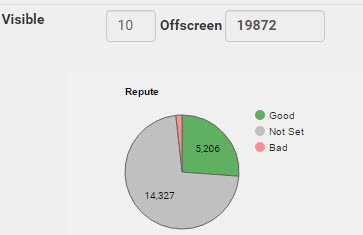
You have a bunch of filter options as I have 19872 gene values of which 349 are bad.


By default it will sort by magnitude descending but you can customize your search many different ways.


If I just show the bad and sort by magnitude Hereditary Hemochromatosis is the second entry.  I actually have something above it and I've now found out I'm an APOE e4 double carrier.  Wow, I really nailed the genetic lottery.


It means I'm at a very high risk for Alzheimer's.  I basically have a 1 in 2 shot to get Alzheimer's by the age of 80.  It also means I'm a slow recycler of cholesterol so my lipid panel is going to be higher regardless of what I eat.  Not the greatest news in the world but I'm a firm believer that it is better to know and act accordingly.  I can now try to stay on top of the latest Alzheimer's research and obviously I'm looking at everything to improve brain function.  More info on APOE e4 and what I'm doing about it is too much for this post but I'll cover this more in the future.  However based on this finding and some of the other findings from Rhonda's gene report I have reduced my saturated fat intake a bit and switched it over to more poly and mono fats.  So Olive oil instead of butter in some spots.

Talking of fat intake you can also use your data to plug into this flowchart from this article and see what kind of diet and exercise is best for your body.


rs4994 8 37823798 AA
rs1042713 5 148206440 GG
rs1799883 - don't have that one
rs1801282 3 12393125 CC


Interestingly it says I will lose more weight on a low fat diet.  This is the opposite to how I eat as I eat a high fat diet.   Of course I don't need to lose weight either so you have that, still interesting anyway and the price is right (free).

So I then took this concept to the next level and had DNAFit analyze my 23andMe data.  DNAFit is a site based in the UK a bit like 23andMe but they gear specific Diet and Exercise strategies for you based on your genes.  They also accept the 23andMe data feed. There are a number of options between Diet and Exercise and how much data you want.  It can cost anywhere from $79 to $400 if you already have the 23andMe data.  I went with the basic info for Diet and Exercise and it cost $149.  If you had to get the gene test as well you're looking at $400.  In of itself its probably too expensive for most people but if you do already have the 23andMe data it has some pretty interesting info.  I got back 3 reports, one on diet, one on fitness and a nice one page infographic you can see below.


If you want to view the full report pdf's for me you can get them here.

Fitness
Power/Endurance Profile


So I'm more of a power responder and I would agree I'm a better sprinter than an endurance athlete.  But I also have the body of an endurance athlete and am a hard gainer in the gym.

Aerobic Potential (VO2 Max)


Recovery


Based on this they do make post exercise nutrition recommendations.


Its pretty basic because personally I can't take Vitamin C because that increases my iron absorption which isn't good with HH and as we saw on Rhonda Patrick's  report Vitamin E can be harmful for me.  So I'll ignore these, but the concept is interesting.

Injury Risk


Diet

Carbohydrate Sensitivity


This seems to line up with what I'm seeing from taking frequent blood glucose readings.  Something I still struggle with but I'll expand on that another time.  I do eat low carb high fat.  Also most of the carbs I do take in are from potatoes, white rice, starchy veg and a minuscule amount of fruit.

Fat Sensitivity


They also go over the following, if you're interested check out the whole report for me here.

Anti Oxidant Need
Omega 3 Need
Vitamin B Needs
Vitamin D Needs
Salt Sensitivity
Alcohol Response
Caffeine Sensitivity
Lactose Intolerance
Coeliac Predisposition

So overall there is some pretty interesting info.  I would take some of it with a grain of salt but I found it at least more informative than just the plain 23andme and in some cases it supports ideas that I already had in particular my carb tolerance.

Finally you can compare some of your stats to olympic athletes, unsurprisingly all from the UK. As of this writing: Craig Pickering (Sprinter, Bobsleigh), Greg Rutherford (Long Jump) and Andrew Steele (400 M).  Nothing useful here but a bit of fun.  I choose Craig as he is a Sprinter.


I'm on the left you would think his power response would be higher as a sprinter.

Finally the closet Libertarian in me should probably point out the potential privacy issue with getting your DNA data.  There have been cases of the police requesting data from 23andMe and making people suspects based on this.  Read this Wired article.  That's kinda scary and also the idea of your data getting handed over to a health insurance company and your rates being adjusted based on your genetic makeup are not out of the realm of possibility.  However you can delete your data from 23andMe by written request

Account Deletion: You have the right to delete your genetic information from our systems. Within thirty (30) days of receiving your written request, we will delete your account, and your information will not be included in any future research, including future research by other organizations. Any research conducted prior to the end of the thirty (30) day period following receipt of your request will not be altered or halted. Once your account is deleted it will not be retrievable. For purposes of clarity, any user-generated content you contribute will not be deleted and your genetic information associated only by barcode may be retained at the laboratory. Click here for more information.
This is not something I've done yet but will probably make that request at some point.  It also means you should probably be fairly careful in what other tools use your data.  So just keep that in mind if genetic testing is something you want to try.


Resources/Links

Training in Line W/ Your Genetic Potential Can Boost Your Performance Gains More Than 600%, DNAFit™ Studies Say

Tuesday, April 26, 2016

Hereditary Hemochromatosis

I recently discovered I have Hereditary Hemochromatosis (HH).  It is essentially a gene mutation that means I'm susceptible to iron overload.  If affects over 1 million Americans.  The gene mutation is prevalent in Hispanics and in about 20% of people of Northern European decent.

So if you have the gene mutation your intestines will absorb twice as much iron from food as normal, and the excess iron will slowly build up in the body tissues.  Many cases go undiagnosed because doctors and patients are unaware of the condition and don't know what to look for.  Early symptoms are fatigue, sore joints and frequent infections, so they are easy to mistake for other conditions.

As the excess iron builds up in the organs, especially the liver, heart, spleen and pancreas it will destroy cells.  Most people won't notice any symptoms until after the age of 30.  Woman are less at risk for iron buildup because of the blood loss from their monthly menstruation.  Left untreated the organs will literally rust inside.  Average age of death is 57 mostly from liver cancer (30%).  It can also cause liver cirrhosis, heart failure, diabetes and arthritis.

So how do you figure out if you have this problem.  The two leading indicators are going to be Iron Ferritin (long term iron storage) and Transferrin Saturation %.  If Ferritin is over 200 or Saturation is over 45% you could be a carrier.  Iron Serum is not a good indicator and I can verify that as I had some normal Iron Serum levels in the past.  Chris Kresser has a great video on iron overload and what levels to look for.

I do find it a little surprising considering how easy this is to test for and treat, why is this not more of a standard screen for hispanics and people of european decent?  Seems like a no brainer to have your iron levels tested after the age of 30.  I'm extremely lucky as I have been doing a lot of my own testing lately to optimize my health and the first indicator was an iron serum level.  After that I got an iron panel done.


From here I went ahead and got my Ferritin level checked.


The testing company I used actually called me to let me know this was serious.  Its pretty apparent that I have iron overload.  I found this flow chart for diagnosing causes of Iron overload, this was from a guide for Australian GPs.


So from here I needed to see if I had the genetic mutation for HH.  You can have your doctor order the HFE Gene test or you can do what I did which was a order a genetic test from 23andMe and check yourself.  I choose this route as there was other information in the gene test I was interested in aside from figuring out if I had HH.  The test is $200 and you spit in a tube and it took 9 weeks to process.  You can read more about my genetic testing here.

Once you get the 23andMe results it doesn't just tell you if you have HH or not.  You have to use the raw data piece to figure it out.  This pdf will tell you how to do that.

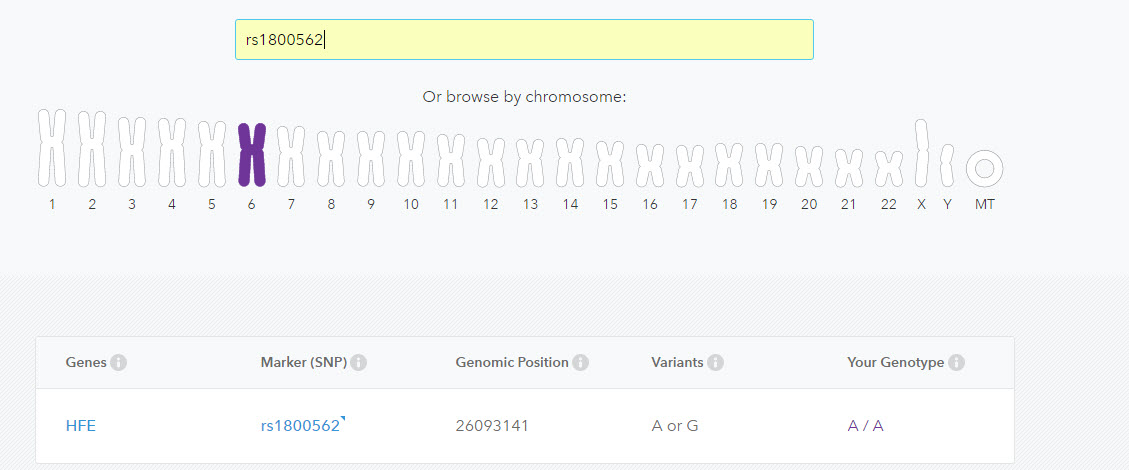
Below is me entering the SNP number for C282Y on 23andMe.  It shows I have the AA genotype which means I have the double mutation.  GG would be normal.


Or you can take the 23andMe raw data file and feed it into a tool like Promethease ($5).


During this time I sent the results to my family doctor and he scheduled me in for a visit and also had me take another Ferritin test.

Ferritin262.5 ng/mL21.8 - 274.7 ng/mL

My doctor was not overly concerned because my results fall within the reference range on their test.  The problem with these reference ranges are they are 2 standard deviations from the curve.  In other words they include 95% of people's test results.  These ranges are definitely not optimal and always keep that in mind when looking at your blood test results.  Fortunately I had done my research already and knew the optimal range was more like 50-150.  You have to be an advocate for your own health and not assume the doctor knows everything.  I also had already ordered the gene test.  I did ask for another Ferritin and iron panel test to just see where things were while I waited for the gene test.  I took it about 3 weeks later.

ComponentYour ValueStandard Range
Iron162 MCG/DL65 - 175 MCG/DL
Iron Bind Cap Unsat65 MCG/DL110 - 370 MCG/DL
Iron Bind Cap Total227 MCG/DL228 - 428 MCG/DL
% Saturation71 %11 - 70 %

ComponentYour ValueStandard Range
Ferritin239.8 ng/mL21.8 - 274.7 ng/mL

The doctor was again ok with the results.  However by this time the gene test had come back and I had verified I had the double gene mutation for HH.  So I just faxed my doctor the page that showed that and I was referred to a Hematologist.

To remove the iron the best and simplest method is to give blood.  I had looked into just donating blood to get the ball rolling.  But I found out I can't give blood here because I lived in the UK for more than 5 years after 1980 (Mad Cows Disease).  While I waited I did take Lacktoferrin (comes from breast milk binds to iron), stopped eating liver, no more supplemental vitamin C (increases iron absorption) and in general tried not to eat too much red meat.

I met with the Hematologist and the first thing she asked was if I was a scientist.  Huh?  I thought that was funny but I explained I was just really into in my health.  I guess they were a little confused when I faxed in the SNP ids from one of my gene reports.  She had no idea I could get this information myself.  She confirmed that I had HH.  Based on my iron levels she recommended I give a pint of blood every 2 weeks for 6 weeks and then have my iron levels retested.  I was also scheduled for an ultrasound to check for any potential damage to the liver.  There isn't any set frequency of blood draws it just depends on the person and their levels.  First they have to get the Iron level down to a reasonable level.  I was glad to hear my Hematologist was targeting a Ferritin level of 50.  This would be the low end of the normal scale so it leaves room for build up until you get the next blood draw.  However you don't want to go too low because at the other end of the scale is Anemia which is caused by too little iron.  Once you get the levels down you then have to go on some sort of maintenance schedule and basically give blood for the rest of your life.  Typically it would be something like once every 2 months but for me we haven't determined that schedule yet.

My kids will also eventually have to be tested.  I was told to test them at 18.  They are guaranteed at least one copy of the mutated gene from me since I have 2 copies.  Its unlikely they would get another copy from my wife but still possible.

9/27/2017: Since the writing of this post I went ahead and had a 23 and me test done for my wife as I was just too curious to know if my kids could potentially have HH.  She is GG for rs1800562 so combined with my AA they are all going to be heterozygous for C282Y.  This means they will be at a slight risk for iron overload but are very unlikely to develop iron overload like I have.  I'll probably recommend they still give blood once a year once they are 18 as it won't hurt and its a good thing to do.


Friday, April 22, 2016

Daily Steps

In my previous post about office work outs I waxed poetic about the need to move more at work and my brother asked the simple question "how many steps do you walk a day?".  I had no clue but threw out 4000 steps as if I had one.  Acting upon his suggestion I thought it would be interesting to see what affect different strategies had on my daily step count.  Parking further from the office sounds good but how much does that really gain you and what do I have to do to get to that magic 10,000 step number without retiring early.

First step was to finally purchase a pedometer/step counter.  I just wanted a plain jane step counter that synced with my phone, had semi decent software and was cheap.  I also didn't want a wrist mounted counter.  Based on that criteria I went with the Jawbone UP for only $25.


The central disk can come out of this clip on and you can insert it into a wrist strap for an additional $10.  In fact if you want to use the sleep tracking feature you will need to purchase the wrist strap to sleep with it on your wrist.  However there are some questions on how accurate the sleep trackers are on these types of devices so I don't even use that feature.  Also frankly sleep is definitely not an area I struggle with.  It does track calories also but apparently it doesn't do a great job of that either, so don't go changing what you eat based on the tracker.


However I was strictly interested in steps and this does the job.  I tested the accuracy of the device at the Butler University track.


For steps it was very close 1198 (actual) vs 1212 (step tracker).  This was for 800m.  However the step tracker is off on mileage as it equates 2000 steps to 1 mile and you can see that for me at least 1 mile is roughly 2400 steps, so it overestimates mileage by 20%.

The clip on is very good and does a nice job of attaching itself to wherever you place it.  I just leave it on my belt and I'm good to go.  A good in depth review of the device can be found here.

So first off I needed a step count baseline.  This is me doing what I used to do at work.  Drive to work, park as close as possible, drive to gym, do the same, go home, sit around and watch tv.  Also I took off the step counter at the gym as I just wanted to get an idea of my total movement for a day without a massive spike if I happened to be running that day.


Now I implemented some of the tips from my office work out post.

I parked further away from the office.  Any distance gained here is multiplied by 4 as I drive to the gym at lunch. +350

Before

After


I walked the stairs twice.  I timed one run and it took almost exactly 4 mins and gained me 325 steps.  So that's good for +650.

I parked further away at the gym. +125

Afternoon ping pong session. +500

Wife Called (I walk when I get calls on my cell phone). +100

This is what the day looked like.  The early evening spike was shopping.


This is my most recent worst day.  This is what it looks like when I work from home, the weather sucks and I'm heads down in work and ignore nearly all reminders to even just stand up.  It's not pretty.


And my best day to date.  Surprisingly this was actually a work day but in general my best days are on the weekend.  This day included my normal work routine, a couple of calls from the wife, boys soccer practice (I walked around field and watched), cut the grass and did some late night moving of boxes.


Edit: since writing this I improved my best and this was on a weekend.  We were preparing the house to be sold and I was pretty much moving somewhat all day.  The big spike is about a 2 mile walk I took while Lennox our youngest slept.


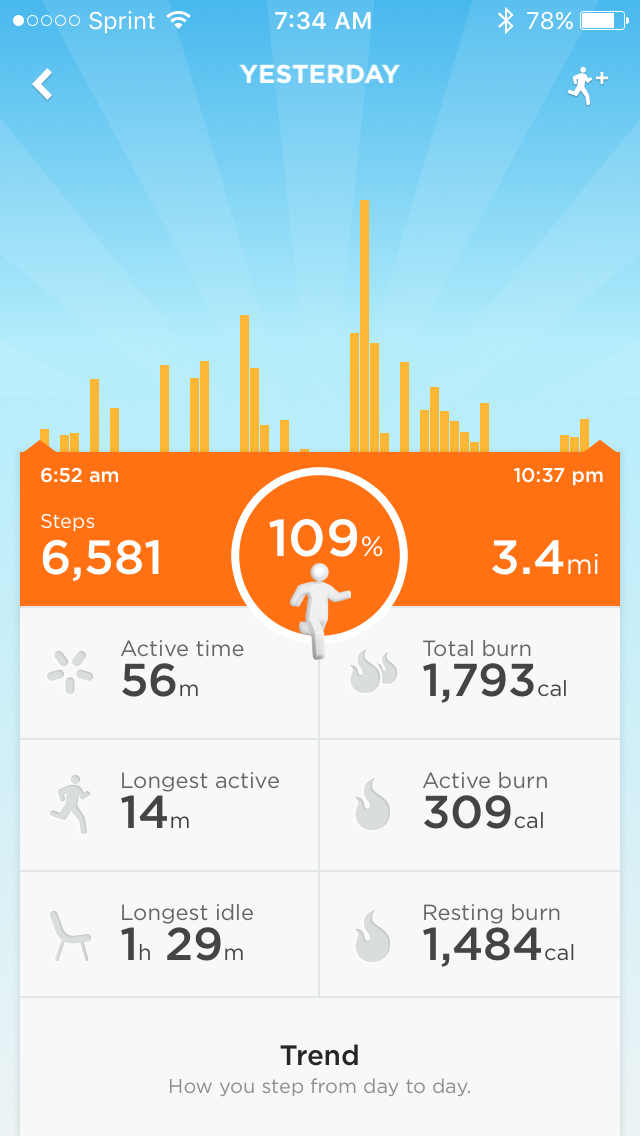
So there you have it based on all this I've set my daily goal as 6000 steps.  For a typical work day this is a realistic goal that requires a bit of effort to hit.  Anything higher just isn't realistic on a work day.  I try to get higher on the weekends, especially now the weather is getting nice.  So with a few modifications it is not too hard to get that daily step count up.  Since upping my step count I have definitely noticed a marked improvement in my general stiffness and mobility.  My lower back pain is a complete non issue now and perhaps this will also help with me finally touching my toes, I can dream can't I?

Other resources