Tuesday, April 26, 2016

Hereditary Hemochromatosis

I recently discovered I have Hereditary Hemochromatosis (HH).  It is essentially a gene mutation that means I'm susceptible to iron overload.  If affects over 1 million Americans.  The gene mutation is prevalent in Hispanics and in about 20% of people of Northern European decent.

So if you have the gene mutation your intestines will absorb twice as much iron from food as normal, and the excess iron will slowly build up in the body tissues.  Many cases go undiagnosed because doctors and patients are unaware of the condition and don't know what to look for.  Early symptoms are fatigue, sore joints and frequent infections, so they are easy to mistake for other conditions.

As the excess iron builds up in the organs, especially the liver, heart, spleen and pancreas it will destroy cells.  Most people won't notice any symptoms until after the age of 30.  Woman are less at risk for iron buildup because of the blood loss from their monthly menstruation.  Left untreated the organs will literally rust inside.  Average age of death is 57 mostly from liver cancer (30%).  It can also cause liver cirrhosis, heart failure, diabetes and arthritis.

So how do you figure out if you have this problem.  The two leading indicators are going to be Iron Ferritin (long term iron storage) and Transferrin Saturation %.  If Ferritin is over 200 or Saturation is over 45% you could be a carrier.  Iron Serum is not a good indicator and I can verify that as I had some normal Iron Serum levels in the past.  Chris Kresser has a great video on iron overload and what levels to look for.

I do find it a little surprising considering how easy this is to test for and treat, why is this not more of a standard screen for hispanics and people of european decent?  Seems like a no brainer to have your iron levels tested after the age of 30.  I'm extremely lucky as I have been doing a lot of my own testing lately to optimize my health and the first indicator was an iron serum level.  After that I got an iron panel done.


From here I went ahead and got my Ferritin level checked.


The testing company I used actually called me to let me know this was serious.  Its pretty apparent that I have iron overload.  I found this flow chart for diagnosing causes of Iron overload, this was from a guide for Australian GPs.


So from here I needed to see if I had the genetic mutation for HH.  You can have your doctor order the HFE Gene test or you can do what I did which was a order a genetic test from 23andMe and check yourself.  I choose this route as there was other information in the gene test I was interested in aside from figuring out if I had HH.  The test is $200 and you spit in a tube and it took 9 weeks to process.  You can read more about my genetic testing here.

Once you get the 23andMe results it doesn't just tell you if you have HH or not.  You have to use the raw data piece to figure it out.  This pdf will tell you how to do that.

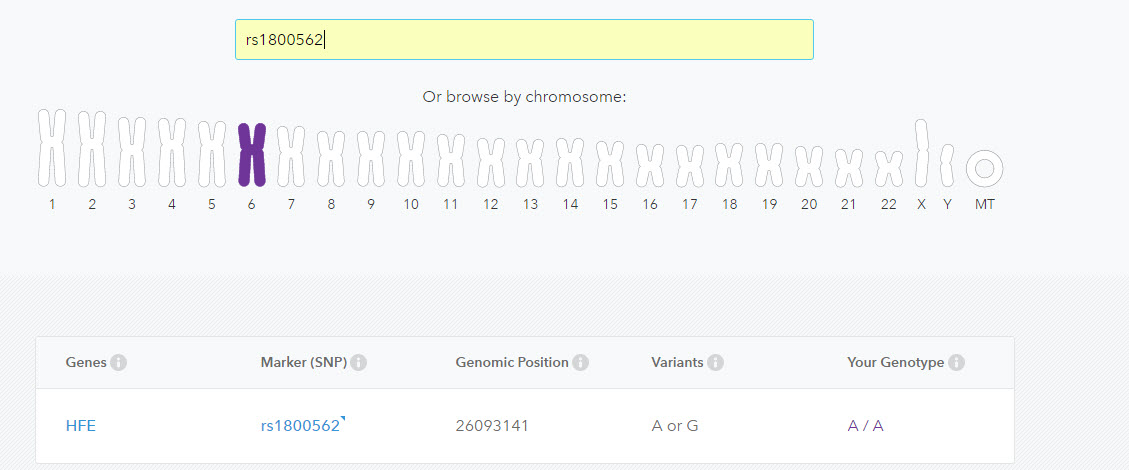
Below is me entering the SNP number for C282Y on 23andMe.  It shows I have the AA genotype which means I have the double mutation.  GG would be normal.

Or you can take the 23andMe raw data file and feed it into a tool like Promethease ($5).


During this time I sent the results to my family doctor and he scheduled me in for a visit and also had me take another Ferritin test.

Ferritin262.5 ng/mL21.8 - 274.7 ng/mL

My doctor was not overly concerned because my results fall within the reference range on their test.  The problem with these reference ranges are they are 2 standard deviations from the curve.  In other words they include 95% of people's test results.  These ranges are definitely not optimal and always keep that in mind when looking at your blood test results.  Fortunately I had done my research already and knew the optimal range was more like 50-150.  You have to be an advocate for your own health and not assume the doctor knows everything.  I also had already ordered the gene test.  I did ask for another Ferritin and iron panel test to just see where things were while I waited for the gene test.  I took it about 3 weeks later.

ComponentYour ValueStandard Range
Iron162 MCG/DL65 - 175 MCG/DL
Iron Bind Cap Unsat65 MCG/DL110 - 370 MCG/DL
Iron Bind Cap Total227 MCG/DL228 - 428 MCG/DL
% Saturation71 %11 - 70 %

ComponentYour ValueStandard Range
Ferritin239.8 ng/mL21.8 - 274.7 ng/mL

The doctor was again ok with the results.  However by this time the gene test had come back and I had verified I had the double gene mutation for HH.  So I just faxed my doctor the page that showed that and I was referred to a Hematologist.

To remove the iron the best and simplest method is to give blood.  I had looked into just donating blood to get the ball rolling.  But I found out I can't give blood here because I lived in the UK for more than 5 years after 1980 (Mad Cows Disease).  While I waited I did take Lacktoferrin (comes from breast milk binds to iron), stopped eating liver, no more supplemental vitamin C (increases iron absorption) and in general tried not to eat too much red meat.

I met with the Hematologist and the first thing she asked was if I was a scientist.  Huh?  I thought that was funny but I explained I was just really into in my health.  I guess they were a little confused when I faxed in the SNP ids from one of my gene reports.  She had no idea I could get this information myself.  She confirmed that I had HH.  Based on my iron levels she recommended I give a pint of blood every 2 weeks for 6 weeks and then have my iron levels retested.  I was also scheduled for an ultrasound to check for any potential damage to the liver.  There isn't any set frequency of blood draws it just depends on the person and their levels.  First they have to get the Iron level down to a reasonable level.  I was glad to hear my Hematologist was targeting a Ferritin level of 50.  This would be the low end of the normal scale so it leaves room for build up until you get the next blood draw.  However you don't want to go too low because at the other end of the scale is Anemia which is caused by too little iron.  Once you get the levels down you then have to go on some sort of maintenance schedule and basically give blood for the rest of your life.  Typically it would be something like once every 2 months but for me we haven't determined that schedule yet.

My kids will also eventually have to be tested.  I was told to test them at 18.  They are guaranteed at least one copy of the mutated gene from me since I have 2 copies.  Its unlikely they would get another copy from my wife but still possible.

9/27/2017: Since the writing of this post I went ahead and had a 23 and me test done for my wife as I was just too curious to know if my kids could potentially have HH.  She is GG for rs1800562 so combined with my AA they are all going to be heterozygous for C282Y.  This means they will be at a slight risk for iron overload but are very unlikely to develop iron overload like I have.  I'll probably recommend they still give blood once a year once they are 18 as it won't hurt and its a good thing to do.


Friday, April 22, 2016

Daily Steps

In my previous post about office work outs I waxed poetic about the need to move more at work and my brother asked the simple question "how many steps do you walk a day?".  I had no clue but threw out 4000 steps as if I had one.  Acting upon his suggestion I thought it would be interesting to see what affect different strategies had on my daily step count.  Parking further from the office sounds good but how much does that really gain you and what do I have to do to get to that magic 10,000 step number without retiring early.

First step was to finally purchase a pedometer/step counter.  I just wanted a plain jane step counter that synced with my phone, had semi decent software and was cheap.  I also didn't want a wrist mounted counter.  Based on that criteria I went with the Jawbone UP for only $25.


The central disk can come out of this clip on and you can insert it into a wrist strap for an additional $10.  In fact if you want to use the sleep tracking feature you will need to purchase the wrist strap to sleep with it on your wrist.  However there are some questions on how accurate the sleep trackers are on these types of devices so I don't even use that feature.  Also frankly sleep is definitely not an area I struggle with.  It does track calories also but apparently it doesn't do a great job of that either, so don't go changing what you eat based on the tracker.


However I was strictly interested in steps and this does the job.  I tested the accuracy of the device at the Butler University track.


For steps it was very close 1198 (actual) vs 1212 (step tracker).  This was for 800m.  However the step tracker is off on mileage as it equates 2000 steps to 1 mile and you can see that for me at least 1 mile is roughly 2400 steps, so it overestimates mileage by 20%.

The clip on is very good and does a nice job of attaching itself to wherever you place it.  I just leave it on my belt and I'm good to go.  A good in depth review of the device can be found here.

So first off I needed a step count baseline.  This is me doing what I used to do at work.  Drive to work, park as close as possible, drive to gym, do the same, go home, sit around and watch tv.  Also I took off the step counter at the gym as I just wanted to get an idea of my total movement for a day without a massive spike if I happened to be running that day.


Now I implemented some of the tips from my office work out post.

I parked further away from the office.  Any distance gained here is multiplied by 4 as I drive to the gym at lunch. +350

Before

After


I walked the stairs twice.  I timed one run and it took almost exactly 4 mins and gained me 325 steps.  So that's good for +650.

I parked further away at the gym. +125

Afternoon ping pong session. +500

Wife Called (I walk when I get calls on my cell phone). +100

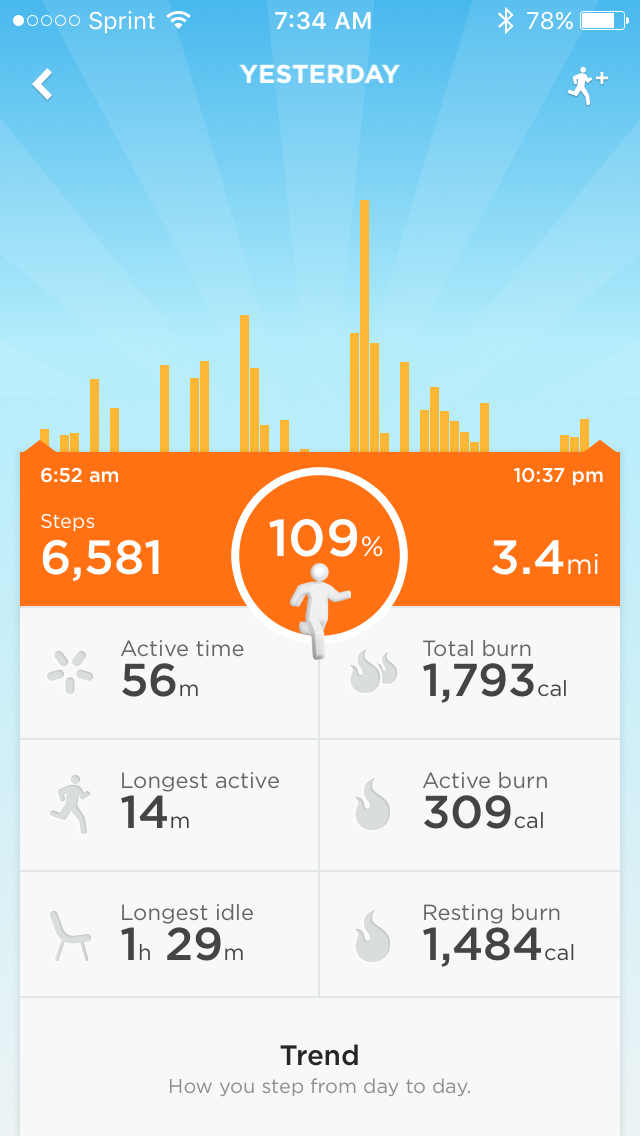
This is what the day looked like.  The early evening spike was shopping.


This is my most recent worst day.  This is what it looks like when I work from home, the weather sucks and I'm heads down in work and ignore nearly all reminders to even just stand up.  It's not pretty.


And my best day to date.  Surprisingly this was actually a work day but in general my best days are on the weekend.  This day included my normal work routine, a couple of calls from the wife, boys soccer practice (I walked around field and watched), cut the grass and did some late night moving of boxes.


Edit: since writing this I improved my best and this was on a weekend.  We were preparing the house to be sold and I was pretty much moving somewhat all day.  The big spike is about a 2 mile walk I took while Lennox our youngest slept.


So there you have it based on all this I've set my daily goal as 6000 steps.  For a typical work day this is a realistic goal that requires a bit of effort to hit.  Anything higher just isn't realistic on a work day.  I try to get higher on the weekends, especially now the weather is getting nice.  So with a few modifications it is not too hard to get that daily step count up.  Since upping my step count I have definitely noticed a marked improvement in my general stiffness and mobility.  My lower back pain is a complete non issue now and perhaps this will also help with me finally touching my toes, I can dream can't I?

Other resources

Wednesday, March 23, 2016

2015 Fitness Goal - Touching My Toes Update

My fitness goal for 2015 was touching my toes.  Its been 3 months since my failed attempt to touch my toes at the end of 2015.  However that does not mean I've given up on the goal.  In the last 3 months I've added a number of things to try and facilitate my goal.  I mentioned to my chiropractor my goal of touching my toes and he said I could try to work on the brain neural piece.  Part of my pitiful flexibility could be my brain just not allowing me to stretch further.


So I did some work with them on this contraption.


They had me do a number of exercises, some with my eyes closed, eyes open, squeezing my legs together, a number of different things.  We would then retest my toe touch to see if anything had an affect on the distance.


Eventually we found something that showed a marked improvement in my toe touch.  Based on that I was given this exercise to do at home.  You basically squeeze as hard as you can with your legs and pull with your arms for 10 seconds then release.  Do this for 3 sets.


The first night I went a little ballistic with this exercise and did it on and off for an hour.  Surprisingly I was able to touch my toes after all that.  However 10 mins later the effects had worn off but there was definitely something going on.

Also based on the following article.  I added a "banded pigeon" to the rotation of stretches I was doing.  Well that's what I'm calling it, I know the pigeon from yoga and well this has a band involved. Check out the article it has some good suggestions in there.  My hips have long been a serious area of tightness so it can't hurt either way.


The band I use is a Rogue fitness band, the green one obviously.  

So after another 3 months (15 total) of work here are the results.


Now Compare that to my previous results over 15 months.

Graphically here is my progress


So there you go, I think based on this I should in theory be able to touch my toes in about 3 months. If I do a ton of stretching and exercises I can now touch my toes so I guess you could say I reached my goal finally.  Hopefully soon I will be able to touch with minimal warm up.  Next up Van Damme chair splits.


PREV - 2015 Fitness Goal - Touching my toes
NEXT - 2015 Fitness Goal - Touching My Toes Update 21 Months

Sunday, February 21, 2016

2016 Fitness Goal - Muscle Up First Attempt

Last year my fitness goal was to touch my toes.  Still working on that one....  My fitness goal for 2016 is a muscle up.  It is basically a pull up into dip over the bar all in one fluid motion.  There are various variations but I'll be trying to do a straight bar muscle up with a kip.


Here is my first muscle up attempt on 2/19/2016.  I had been working on my pull ups quite a bit in the last 12 months and at this point I can do about 6-8 good form pull ups.


Another attempt, same result


I have 1 day a week dedicated to muscle up training.  I've started off with the following

3 * Regular Pull ups
3 * Dead Hang
3 * Knees to Elbows (hang from bar and swing your legs up till your knees touch your elbows)

I'm also doing straight bar dips at the office and working on my grip strength with my captain of crush grippers.  I'm going to add some things from the following and start doing some variations of the initial pull up movement

Hat tip to Erik Aho from work who suggested this video series.


Also from this article, I'm going to do some box to dip practice to get a feel for the final movement and that transition where I get totally stuck.


Tuesday, February 16, 2016

Office Work Outs

I already shared my office setup that showed my stand up desk setup, chair and a few other gadgets.  We know that sitting all day is bad for us.  Even if you are working out everyday for 30 mins and getting your recommended amount of exercise but living a sedentary lifestyle you still won't be healthy.

Here's a study where they examined the sedentary behavior among elite professional footballers (soccer)

Another good article on why sitting all day might be undoing your time in the gym.

However standing all day isn't the answer either and you will have similar problems if you just stand all day.  The key is constant movement and positional changes.  I'm a big fan of Katy Bowman's philosophy on movement and her book move your dna.

How do you achieve that when you have to work at a computer for 8 hours a day?

The first thing you need is a timer or reminder system to let you know its time to take a break or move.  I use Workrave, it is free and very customizable.  Another article on some other options which I have no experience with.


The defaults on Workrave are quite intrusive.  I've settled on a micro break every 10 mins and rest break every 30 mins.  It seems to be the general consensus that you need to do something every 30 mins to undo the damage from sitting.

For the micro break a little reminder will pop up on the top of your screen.


If you keep working it will just disappear and then reappear based on the postpone time you set.  If you want to take the break you have to stop typing and moving the mouse.  The screen will then lock for the time that you set, which in my case is 15 seconds.  During these micro breaks I will simply do a quick stretch or stand up for a second.  I also avert my eyes from the screen and focus on something in the distance to avoid eye strain.  Fortunately I have a window in my office, but you could also look across the room or whatever far point is available to you.

Every 30 mins I take a rest break for 1 min 30s.  This is where I will do a little more stretching or exercises and I will also often switch to standing or sitting.  One of the nice things about Workrave is that it gives you exercises to do while the screen is locked.


So you can just follow along, or do something on your own.  Here are some more ideas for things to do from Sitting Solution.  


You will get some funny looks from other employees and I've been asked if I was ok when I was in cube land and doing cat cows on the floor.


Here are some of the different sitting/standing positions I use.


A little difficult to see because the half moon foam pad is black but I'm stretching my calf on it in the above pic.


Ultimately I probably take less breaks than this as I often postpone breaks if I'm heads down but just having the reminder there is a good way to keep me honest.  

There are some annoyances with Workrave.  It tries to figure out if you're working and when you aren't it pauses the timer.  This can be somewhat annoying if you're reading a document because it will pause the timer that whole time.  You can set it to reading mode which will turn this feature off


but you have to remember to do that after each time you start Workrave or there are some regedit hacks you can do to change the settings.  Check out this article and in particular the comments section for how to edit your regedit file.  Not recommended if you're not technically inclined.

Aside from the breaks with stretching there are a couple of other things I do.  When its nice out I will take the occasional walk but everyday I walk the stairs a couple times a day.  


Once in the morning and once in the afternoon.  I work on the 2nd floor and the building has 6 floors.  So I take my captain of crush grippers and head for the stairs.  Walking up 2 steps at a time I alternate hands with the gripper every flight.  Once at the top there is a straight bar railing and I do 10-15 straight bar dips. 


Not only am I greasing the groove but this will help me with my 2016 fitness goal to do a muscle up as the final movement is a straight bar dip.  I then do a little core work on the hand rails, hold this for 15 seconds or so.


Ok my form looks nothing like that but you get the idea, then head back down.  On the way down I'll swing down using the hand rails.  Just another way to get a different movement in my day.  This all only takes about 4 mins and I'll do it when I need to go to the bathroom so any work time lost is absolutely minimal.

Finally 10-15 mins on the ping pong table in the afternoon.  This will actually get my heart rate up to around 115.


Other options are to walk while you take any phone calls on your phone.  You could try doing a walking work meeting.  Park your car further away.  Take the stairs over the elevator.  Get creative there are plenty of options but the key is to move as much as possible in different ways and not stay in a static position whether that's sitting or standing.  Sitting all day and then killing yourself with a 30 min crossfit wod won't make you healthy.

Other resources


Tuesday, January 19, 2016

Office Setup

I'm sure you've heard that sitting is the new smoking.  Well I wanted to share my office setup so you can see some of the tools I use to try and counter act the lack of movement throughout the average work day.

Fortunately for me I have a pretty progressive employer who understands the benefits of making employees happy.  Based on employee feedback we were given the choice of a sit/stand desk or a new chair (we had a choice of 4 different chairs that we could try out).  It was a no-brainer for me to go for the sit stand workstation.  A new chair doesn't address the fact that I would still be sitting all day.  The one you see in the picture is an Ergotron, I think they are around the $500 range.  When I first got the desk I was standing 30 mins at a time sometimes longer.  However I started to get calf cramps in the middle of the night.  At first I thought it was my workouts or a mineral deficiency of some kind but I couldn't figure it out.  However eventually I realized it might be the amount of time I was standing.  I eventually settled on standing 10 mins of every hour.  Now I tend to stand a little longer but with less frequency.

Office Setup


That fancy looking chair I have is a HAG Capisco Chair.


I bought it sight unseen.  I had been looking for an alternative chair for a while as a regular chair really bothers my lower back.  I heard Joe Rogan talk about the chair on his podcast.  It is $850.  I really balked at the price of this chair but once I figured how much I would be using it I treated it like a bed purchase and that it really would be worth while to make the investment in the chair.  My fairly constant lower back pain was also a good motivator to purchase the chair.  The particular model I got is designed to work with a sit stand desk and when you sit in it you don't really use the back of the chair as it naturally puts you in more neutral spine position.  I also like that you can adjust the height and sit a little higher up like a bar stool.  It works great with the sit stand desk in this way and enables me to adjust my seating position throughout the day.  It is still possible to slouch and have your pelvic tilt but it starts you in a much better position.

The mouse I use is an Evoluent vertical mouse.  A coworker turned me onto these.


I switched to this to take some pressure off my right wrist.


You can see in the picture where a lot of the pressure was on my wrist with a regular mouse.  This is from years of working on a computer.  It took a little while to get used to the mouse but overall I think my wrist thanks me for the change.


I use an anti fatigue mat to stand on when I'm standing.  I bought this Joe fatigue mat for $14 and have been very happy with it for the price.  The carpet is very minimal and the floor is quite unforgiving if you're standing on it.  I also take my shoes off when I'm at my desk.  I use the golf ball to massage the bottoms of my feet when I'm sitting.  When I'm standing I use the half moon foam pad to stretch my calves.  


I have these captain of crush grippers at my desk which I use periodically to improve my grip strength.  They are pretty much the gold standard in grippers and come in various strengths so you can just purchase the next one up once you get strong enough.  I have the sport (80 lbs) and the trainer (100 lbs).  I started on the sport and had a pretty weak grip.  I'm only 140 lbs so your mileage may vary.  You might want to start with the trainer or higher if you already have a strong grip or have bigger stronger hands.


That's a himalayan salt lamp.  My wife got me some of these for xmas and I put one in the office.  She got it here.  They are supposed to negatively ionize the air and have some benefits.  Worst case it gives off a nice soothing glow to bring out your inner hippie.


That's the ping pong table in our game room at work.  Yes we have a game room at work and I play ping pong almost daily.  Great way to break up the day and get some different movements in.  Read more about how I stay healthy during the day with my office work outs.