Tuesday, January 10, 2017

2016 Year in Review

Firstly Happy New Year to my 2 readers.


As for health and fitness its been a pretty big year for me.  Really the highlight and my most popular post was discovering I had Hereditary Hemochromatosis.  I'm planning to post an update but the short story is after 7 phlebotomies my iron is back to reasonable levels (50-150 is optimal).  I'll have to continue with the phlebotomies to keep my iron under control until I die but at a much reduced rate.


How about all my fitness goals?  Lets review shall we because so far I have a pretty poor record of completing any.


2014 - Run 3 miles in 21 minutes

Although undocumented on this blog I did have a goal in 2014 of running 3 miles in under 21 minutes (7 min/mile pace).  I had just started running again and that seemed reasonable at the time as I could run under 21 minutes when I was 12.  However I was only able to run 2 miles in 14 minutes that year but never 3 miles. 

I hurt my ankle for most of this year but got a few runs in at the end of year.  Best 5K - 22:43 7:20 min/mile.  I'll have a lot more on this next year but I've started training to put this one to bed in 2017.


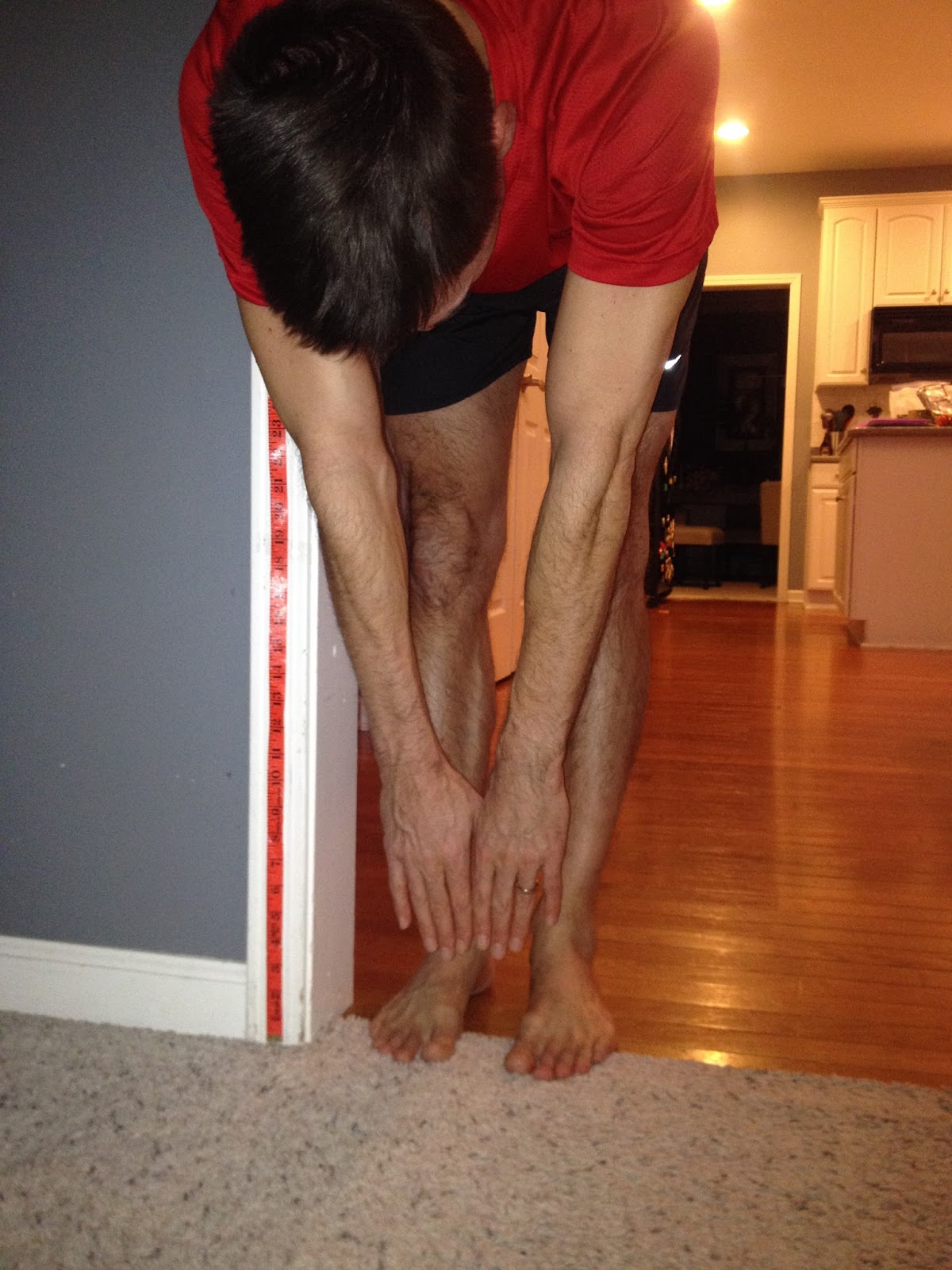
Ah the saga of touching my toes, will have a full update at the end of March, but here is the end of year update.


It's only been a couple of months since I switched my goal to a handstand but I've started the handstand progressions.  Here I am doing a headstand, I'm up to 4 sets of 36 seconds.  Long way to go on this one still.


2017 - Complete the Indiana Spartan Sprint

So here is a goal I might actually be able to finish in a year.  Goal for 2017 is to complete a Spartan Sprint, specifically the Indiana Spartan Sprint on July 9th in Lawrenceburg IN .  Basically a 3-5 mile trail run with 20 or so obstacles.  If you would like to join me and start at the same time I have a team setup named "Hunter".  


 What's your New Years Resolution, goal for the year?  Let me know in the comments.


Friday, October 28, 2016

2016 Fitness Goal - Update Shoulder Extension

For the two of you that actually read this blog you might have noticed something.  What in the world has happened to my 2016 goal of doing a muscle up.  To recap here is my post from Feb with my initial attempt.


We are now at the end of October and I only have 2 months left to complete a muscle up.  I've still been doing strength training aimed at completing a muscle up once a week.  However I have not attempted a single muscle up since the initial attempt back in February.  And the reason is pretty simple my shoulder mobility sucks.  After talking to a trainer who cautioned me against it and also listening to podcasts with ex US team gymnastics coach Sommer, I've decided that the chance for injury in my current state of mobility is much too high.

Tim Ferris Podcasts with Coach Sommer


Basically my shoulder extension is terrible.  If you've been following my trials and tribulations with touching my toes I guess this shouldn't be a surprise to anyone.  Also the fact that I've spent many years sitting and working on a computer, and driving a car with my shoulders hunched over it really shouldn't be a surprise to me either.  So my primary focus right now at least for this particular goal is fixing my shoulder mobility.  

And if you've been working in an office for a long time you likely have the same problem.  If you're curious where you stack up, simply stand straight up with your arms at your side and raise them above your head.  Can you get them to vertical or like me do they seemingly stop moving at a 45 degree angle.  Kind of a terrible picture but here is where I'm currently at and that is a huge improvement from where I was.


So what strategies am I using to restore my shoulder mobility?

Hanging.  I do a lot of hanging from bars, branches, whatever I can find.  Whether its at the gym or the kids playground I don't miss an opportunity to just hang.  This is a fantastic way to stretch your shoulders.  If you're just starting out start with your feet lightly touching the ground or on a box to support you and work your way up to a full weighted hang.  My goal for this is a 2 minute hang.  I've added about 30 seconds in the last 6 months and I'm at 1 minute 30 seconds for my best to date.


Supine Shoulder Extension. Sit down on the floor and place your hands palms down behind you as close together as is comfortable, then shift your hips forward and stretch the shoulders.  Watching TV is a perfect time to do this.


Notice that I can't get my hands very close together and I'm pretty upright still


Table Rocks.  Squeeze your shoulder blades and push your hips to the sky, or in my case just off the ground.

Gymnastic Bodies - Mobility desk workers table rocks


Notice how low my hips are still and this is an improvement from where I started.


Shoulder Dislocates.  Use a wooden dowel, pvc pipe or belt for this.  Start with a wide enough grip that it is comfortable to get up and over your shoulders.  Don't push it, over time you will want to start narrowing your grip.  Don't rush the progression, it feels a little disconcerting the first time you do it and start as wide as possible, get a longer dowel or pipe if necessary.


Notice how wide I have to grip the dowel just to get it over my head, I literally have one finger on the end.  I found my pecs were also incredibly tight on this exercise as well.  Lots of work to do here.

Wall Slides.  This is my go to shoulder exercise for breaks at work as it gets the fewest strange looks.


Finally I'm changing my 2016 goal from doing a muscle up to doing a free standing 30 second hand stand.  The handstand will also require shoulder extension so that doesn't change but should be a little more realistic and much less likely to incur injury than the explosive muscle up.  Also I think it is a good stepping stone to ultimately do a muscle up in the future.  I just started the handstand work so its highly unlikely I'll have anything by the end of the year but I'll post an update of the training I'm doing and where I'm at then.


Links/Resources


Friday, October 7, 2016

2015 Fitness Goal - Touching My Toes Update 21 Months

Argh its that time again.  Its been another 6 months since I updated my progress on touching my toes and frankly its not going that well.  Here is the progress graph, I have officially reached stall out speed.

If you missed them here are my previous posts on the subject

2015 Fitness Goal - Touching My Toes

2015 Fitness Goal - Touching My Toes Update

Here is the progress graph

March 2016 and September 2016


In all my current glory


Although compared to the end of 2015 it doesn't look quite so depressing


We moved houses over the summer so a lot of bands, rollers and other various contraptions were packed away in boxes for a while.  So I had been a little lax on continuing my exercises.  To compound the problem the slow progress has blunted my enthusiasm for painful stretches.  Because of the lack of equipment and the fact that our new house has a hardwood floors on the main floor I added some dynamic type stretching and movements that I could just whip out and do whenever.

Stiff Bear Crawl -  basically keep your legs straight and try to crawl small steps at a time


What it looks like in action


It definitely seems like I'm not getting much bang for my buck on the random stretching and mobility work I'm currently doing.  I don't really have a good plan or set rotation for improving my toe touch at this point.  It currently consists of random sessions when I have some free time typically in the evenings.  I'm still doing yoga once a week.  That all worked up until this point, so starting this month that is about to change.  I've signed up for an online gymnastics course .  Its an online training program called Gymnastic Bodies setup by ex USA gymnastics coach Christopher Sommer.  I've signed up for just the front split stretching series and it was $75.  It is 45 mins once a week and I have to say its pretty brutal.  As of this writing I've done it three times.  I'm hoping this will kick start my progress again with a more structured approach.  We will see....


PREV - 2015 Fitness Goal - Touching My Toes Update
NEXT - 2015 Fitness Goal - Touching My Toes Update 27 Months


Wednesday, August 17, 2016

Saffron Drift Tv

If you read my post on sleep you'll know how important it is to block out blue light in the evenings to fall asleep quickly.  Essentially exposure to blue light in the evenings will block the bodies natural release of melatonin and upset your circadian rhythm.  I counter act this by wearing these ridiculous looking blue light blocking safety specs putting them on around 8-9 pm.  They are only $9.


In fact I looked so stupid my wife suggested I get something a little cooler looking.  So I forked over $90 for these.  


She is much happier with how I look and since I wear them almost nightly its probably a fair investment.

However as I mentioned in my post on sleep you can buy a device that blocks blue light on your TV.  I personally still wear my specs as there are other sources of blue light but my wife likes to watch TV in bed and also has trouble sleeping at times.  So I got this device specifically for the TV in our bedroom to hopefully help her fall asleep with the TV on.  Its called the Saffron Drift TV.  It costs $100 and does not work with 4K and up TV's.  


Its about the size of a thick Iphone 6.  You plug your HDMI into the device and then use the supplied HDMI cable to run to your TV.  If you have multiple devices running to your TV you could use an HDMI switcher to run everything through the Drift Box.


You can set the device with a schedule of your sleep and wake times and the amount of blue light you want blocked and it will gradually adjust the screen depending on the time of the day.  You can also have it just ignore the schedule and block blue light always.  They recommend a target setting of anything under 3500K to help sleep.  I started mine at 3000K to see how the wife liked it.  I must say I was pleasantly surprised with how the picture looked.  Based on my experiences with wearing blue light blocking glasses I was expecting a really orange looking screen but it is much more subtle than that and honestly aside from a slight orange hue you really don't notice the difference that much at all.  Overall I'm really impressed with the picture.  Anecdotal evidence from the wife suggests she is sleeping better but the jury is still out.  It certainly can't hurt for those people that insist they need a TV on to sleep.

Wednesday, July 13, 2016

Monitoring your own health - Blood Glucose

If you asked me what is the one thing I can track myself to monitor my health it would be blood glucose.  This is a measurement of the amount glucose in your blood stream.  Its very simple to do yourself and is cheap.  No fancy blood tests, urine analysis, or scooping poop into a tube.  The simplest measurement is fasting blood glucose.  You simply fast for 12 hours and then measure your fasting glucose.  So eat dinner at 7pm and them measure your fasting blood glucose in the morning at 7am.

I use a ReliOn Prime meter from Walmart.  They are only $10 now and I like them also because the strips and lancets are very cheap, so the cost per reading is very low.


The reference range for blood glucose is 66-99.  However as I've mentioned before the reference range does not stand for optimal range.  Anything over 90 fasting is probably cause for at least more investigation.

The Cleveland Clinic Foundation now uses a fasting blood sugar of 90 mg/dl or higher as a biomarker of coronary heart disease risk. The Cleveland Clinic gets very concerned when they someone with a fasting blood sugar above 90 mg/dl. They try to intervene with exercise, diet and weight control.
Type 2 diabetes isn’t the only disease associated with prediabetes. A meta-analysis that included data from nearly 900,000 people found that those with prediabetes have a 15 percent higher risk of cancer, especially cancers of the liver, stomach, pancreas, breast, and endometrium. 
Fasting Blood glucose of 95 or higher have a more than 3X risk of developing future diabetes than people with a fasting of below 90 
However don't expect your doctor to say anything until you are at least prediabetic.  Diabetes is a very slow developing disease it doesn't just happen overnight.  It takes years to develop the insulin resistance.  Here are my results from a 2014 doctor visit.


As you can see not only am I not even optimal but I'm already slightly above range and not a word from the doctor on this.  A year later I had a result of 113 mg/Dl fasting.  That did finally trigger some comments from my doctor.


Here are the doctor ranges for prediabetic and full blown diabetes.


I think it is much better to take action before you are prediabetic.  Certainly much better than when you have diabetes.  It is much harder to reverse once you are at that point and very insulin resistant although not impossible.

Consider this fictional graph.


This clearly tells a story that your glucose response is getting worse and you are trending in the direction of prediabetes.  However these results are all within range.  The doctor will be more focused on the ranges and if you fall within them.  You need to keep an eye on your trend.  In the above scenario it is highly likely you will get the ok from the doctor but its clearly going to be a problem if you continue on this path.  Use a site like wellnessfx to input all your test results and you can then view them in a nice graph format on their dashboard and look for trends yourself.  I personally don't put my glucose results in there but use a spreadsheet as I have taken so many.  Below is all my data although lately I've haven't been taking many readings.


The blood glucose monitors themselves are not super accurate.  It is not uncommon for them to be off around 10%.   So if you're doing it yourself you will want to take multiple readings over days to get more of a trend than relying on a single entry.  Looking at my own results it certainly appears to be trending in the wrong direction and my results are certainly close to that prediabetic range of 100 - 125.

At least for 2016 YTD I'm trending down so it isn't all bad news.


If you want to get a little more technical and do more analysis above and beyond the fasting number, the next thing to do would be to take your post prandial readings.  Basically it means to take your readings after a meal to see what your glucose response is.  Typically you take it 1, 2 and 3 hours after a meal.  For your post meal 2 hour readings

Normal <140 mg/dL
Prediabetes 140-199 mg/dL
Diabetes >200 mg/dL

These aren't optimal you probably want a 2 hour post prandial < 120 mg/dL.

Here are all my 2 hour post prandial readings, obviously the amount of carbs in the meal is going to greatly effect the results.


So it looks like at least my 2 hour post prandial numbers look pretty decent.  I only have a couple that were above the 120 optimal threshold although I think the vast majority of these meals were pretty low carb.

Here is a closer look at my blood glucose throughout a typical day.  I stay low carb until dinner as you will see.

Breakfast - Coffee & Heavy Cream  (basically fasted)
Lunch - Sardines, Avocado, 3 eggs, Broccoli, Olive Oil, Mayo (avocado oil based)

Lunch Macros


Dinner - Ground Beef, White Rice, Broccoli, Cauliflower, Cabbage, Carrots, Cheese, Sour Cream, Blueberries

Dinner Macros


Here is my blood glucose throughout the day.  I measured it every hour and then every 20 mins for 3 hours after each meal (lunch & dinner).  Yes that is a lot of finger pricks.  I don't normally snack but I did have a spoonful of almond butter at 16:30 as I just wanted to see if there was any response to this type of snack and as I expected there was none.  I think its important to keep the area under the curve (blue area) for the whole day as small as possible.

Here I overlay the 2 post prandial readings so you can clearly see the different responses to meals with carbs and without.  My lunch which is low carb high fat barely even registered but my dinner which has many more carbs particularly from the rice and fruit has a much bigger response.


From the above graph based on my dinner I'm in the not optimal but not in the classic definition of pre diabetes as over 140 after 2 hours.  However it does also spikes back up to almost 140 around 2 hours 20 mins.

Another check is to get your your A1C measured.  Your A1C is basically a 3 month average of your blood glucose.  You can get your doctor to do it or Walmart has home kits for like $20.  For me its kinda of useless since I give blood so often for my Hereidtary Hemochromatosis it messes up my A1C readings.

For A1C
Normal < 6.0%
Prediabetes 6-6.4%
Diabetes > 6.4%

Again these aren't optimal, you probably want an A1C < 5.3%.  Also A1C is not that reliable for some people so it should just be part of an overall snapshot of information, don't use it as your sole data point.

So why do we care about blood glucose readings.  Well the main reason is for prevention of diabetes which is a pretty horrible disease and exploding in developed countries.  Also as mentioned earlier higher blood glucose (even non diabetic ranges) is a marker for heart disease and cancer.  Here are some diabetes numbers according to the CDC  in 2014.

Total:29.1 million people or 9.3% of the population have diabetes.
Diagnosed:21.0 million people.
Undiagnosed:8.1 million people (27.8% of people with diabetes are undiagnosed).

What this looks like over time is an epidemic in diabetes.


So what am I doing to try to improve my insulin resistance and bring my fasting glucose to a normal range?
  • Eating a lowish carb, moderate protein, high fat diet.
  • Saving my carbs for the evening hours
  • No processed sugars or carbs
  • No grains 
  • Very limited fruit, especially fruit that is high in fructose.  I go for more of the dark fruits like blueberries, blackberries etc.  
  • Exercise, weight lifting especially can decrease insulin resistance
  • Intermittent fasting
  • No artificial sweeteners
This is just what I'm doing and with very limited success so far it would seem at least for my fasting number.  I'm taking a wait and see approach as my iron overload from Hereditary Hemochromatosis could be part of the problem.  The liver and pancreas are major players in blood glucose and they both can be affected by iron overload.  Its probably why diabetes is one of the possible outcomes of HH.  This study suggests that iron overload is associated with insulin resistance.  So until my iron is at a normal level I might just be spinning my wheels on this.  I suspect i'll have to get my iron down and then have to reverse the insulin resistance over time.  I'll revisit this once my iron is under control but in the meantime I'll continue to take occasional readings to make sure I'm not slipping in the wrong direction.


Links/Resources

If Your Fasting Blood Sugar is Above 90 You Are At Risk of Heart Disease

How To Prevent Diabetes And Heart Disease for $16

Why your “normal” blood sugar isn’t normal (Part 2)

Why Hemoglobin A1C Is not a reliable marker

Peter Attia's Use of a continuous glucose monitor

The Dawn Phenomenon (High Fasting Reading)

'Healthy' foods differ by individual

Physiological insulin resistance

4 Ways to Control Blood Sugar With Exercise


Monday, June 27, 2016

Sleep

Its never been a problem for me.  In fact my sleeping prowess is pretty legendary among my family.  However this is not the case for many people and the more I learn about health and wellness the more convinced I've become that sleep might be one of the most overlooked aspects of maintaining proper health.  I think diet is still the number one factor but that is closely followed by sleep.  Yes ahead of exercise.  Why is sleep so important?  Well 2 functions of sleep are
  1. your brain cleans up cellular garbage when you sleep
  2. your body repairs itself while you sleep
If you aren't getting this nightly clean up it can manifest itself in some of the following problems.
  1. a decline in immune function
  2. an increase in cortisol, catecholamines, and other stress hormones
  3. imbalances in appetite and blood sugar regulating hormones
  4. increased levels of inflammatory hormones such as interleukin and C-reactive protein
  5. Testosterone and thyroid hormones
  6. lower will power
Just to name a few

Still aren't convinced, check out this TED talk by Dr Doc Parsley.  He discovered the importance of sleep working with Navy Seals.  Nearly all of them had broken sleep patterns and were using sleep aids to help them sleep.


Or perhaps these low performing athletes


“sleep is extremely important to me – I need to rest and recover in order for the training I do to be absorbed by my body.”


  “If I don’t sleep 11 to 12 hours a day, it’s not right.” 

Gareth Bale, yeah you know that guy that is crushing it for Wales in the euro cup at the time of this writing.  He and Real Madrid hired sleep expert Nick Littlehales to help the team.

How Gareth Bale and Real Madrid sleep their way to the top

Ok we get it, sleep is important.  What can I do to sleep better?  Below are all the tools, tips and tricks I have accumulated in no particular order.

1) Avoid blue light in the evenings.  Blue light from TV screens, computer screens, phones, lights around the bathroom mirror etc late in the evening will disrupt your circadian rhythm and block your natural release of melatonin at night which makes you tired.  So either go tech free an hour before bed or alternatively this is what I do, I put on glasses that block blue light around 8-9 pm.  Yes I look like a complete idiot.

I use these cheap $9 safety specs and yes these do really work, you will get tired watching that evening movie or show.


Want something that looks a little cooler, you could spend a bit more and get these.


Or perhaps these, designed for gamers.

Apple obviously thought this was enough of an issue to include it as a new feature in IOS 9.3.  You can now get Night Shift which changes the amount of blue light on the screen depending on the time of the day.  It gives it an orange hue to it.  It only works on iphone 5s or higher and certain ipads.


For your computer screen and some other devices you can install the free utility f.lux.  Below it shows how much light is blocked for a Macbook Air with f.lux turned on.


Or perhaps you don't want to wear some silly glasses and you have a tv in your bedroom.  You can now buy a device that your tv plugs into that will filter the blue light for you depending on the time of the day or whatever schedule you set.  I've bought one of these for the tv in our bedroom as my wife likes to watch tv before bed.  We just moved and its not hooked up yet but I'll give a full report once we start using it.


2)   Make your sleeping room absolutely pitch black, no lights of any kind.  My wife watches tv so I wear a sleep mask and ear plugs.  I use this sleep master mask.  


3)  Keep the room cold 68 deg or lower.  If one of you is hot (normally the woman) and the other cold.  You could try one of these cooling mats for the woman.  They are pretty pricey $450 but some people swear by them. 


4)  Don’t drink alcohol close to bedtime.  More than two glasses of wine within four hours of sleep decreases deep-wave sleep 20–50%. Even four glasses six hours beforehand did not appear to have this effect, so the timing is crucial.


5)  Caffeine.  This can vary widely from person to person but as a general rule I don't drink any after 12 pm, except the occasional spot of tea of course.  The half life of caffeine can vary widely depending on the person based on genetics and other factors.  I'm sure you know that person that can drink coffee right before bed and sleep like a log, it is likely partially due to genes.  Here is my DNA Fit report for caffeine based on my genetics.


Perhaps some soothing tea instead. 

6)  Low blood sugar can kick you out of sleep, if you find this happening eat a low glycemic snack right before bed.  Almond butter on a celery stick for example.


7) Supplemental sleep aids.  As always I'm NOT a doctor so don't take this as medical advice always work closely with your doctor.  I'm not a fan of prescription sleep aids, they are more of a band aid to the underlying problem.  They also just knock you out and don't put you in the restorative REM sleep that you so badly need.  So you will end up with a host of side effects and they are also very addictive.  However if you want to stop using them because you read some hack on the internet and he said so DO NOT STOP COLD TURKEY always work with your doctor.

“There is a vast difference in OTC meds that function off antihistamines (you CAN stop those stop cold turkey) vs. molecular manipulation from prescription medications. Even a product such as Ambien, which is considered a non-benzodiazepine, still binds to the Benzo1 receptor whereas the likes of Valium binds to all benzo receptors. So even though it is marketed and as a non-benzodiazepine, the system still becomes dependent on Ambien just like it becomes dependent on Valium.”
“for folks who are dependent on prescription sleep medications, some physicians are also using acupuncture to rehabilitate the sympathetic and parasympathetic nervous systems, as the prescription meds get these systems way out of balance. It’s recommended to step off sleep meds over a period of a few weeks. For example, if you are taking long-acting 12.5mg benzodiazepine, then get to 10 mg, and try that for 2 weeks.”
Again I'm NOT a doctor.

However there are natural options.  Dr Parsley who did the TED Talk referenced above has a product that uses all the natural supplements that he has found to help with his Navy Seals.  You can purchase his sleep remedy here.  I should probably mention it does contain a tiny amount of melatonin, but it is in such small doses that it shouldn't effect natural melatonin production.  People seem to be all over the map on whether larger doses of melatonin are safe but I'm not convinced that larger doses over a period of time doesn't mess with the bodies natural production.  You can also try individual supplements like GABA, 5-HTP and others, but if you want a one stop shop that is proven and in the right quantities I would go with the sleep remedy.

8) Epsom Salt bath.  Magnesium has a calming effect (its one of the ingredients in Dr Parsley's sleep cocktail), so an Epsom salt bath in the evening can help with sleep.  Preferably a cold bath see below.


9) A cold shower before bed.  Body temperature plays a role in your sleep routine and its why you want a cold room, so along those lines a cold shower will bring down your body temperature and therefore make you fall asleep faster.  One study found that subjects fell asleep faster and had a better overall quality of sleep following behaviors that cooled the body. 


10)  Meditate.  Use a guided meditation app like Calm or Headspace to meditate right before bed.  Especially if you are the type that can’t stop the mind racing.  


11)  Go to sleep before 11.  This is to align with your circadian rhythm.  Sleeping 10-6 is much better for you than sleeping 12-8.  Also if you get to 11pm you will find you will get a spike in energy but I can't remember why.  Whatever it is I don't like to go beyond 11pm.  Easier said then done if you're not a washed up 40 year old with kids.  Incidentally you can reset your circadian rhythm sleeping under the stars for 7 nights, no seriously go camping.  


12) Avoid Wifi.  Do not put wifi or bluetooth devices by your bed.  Turn them off or put them in airplane mode.


1    13)  Pulse Electro Magnetic Earthing device.  Ok I admit this is a bit out there but there is solid science behind it and if I couldn’t sleep I would definitely try this.  They are expensive, the double magnet pro basic is $900. 


Another PEMF device The SR1 DeltaSleeper ($500), it attaches to your collarbone.  The pulse device above  goes under your mattress.  Lots of good info and links also in this article.

14) Binural Beats.  This is basically different frequency noises that are played through each ear.  I have no experience but if you google it you will find plenty of info.  There are also binural beat apps for you phone.  Sleepstream 2 is one for the iphone.

15) If your mind races or you need a TV to fall asleep, try making a list. Again I turn to Dr Parsley from an interview he did.  


Full Transcript

 Most people who say I have to have a television to fall asleep or some people even who say they have to read to get asleep, the reason that they need to do that is because is because they have to distract themselves because if they don't distract themselves their minds will go racing. And I think the biggest problem is not all of the constant external stimulation but the constant internal stimulation and the constant denial of that.
And what that leads to is this constant external stimulation. And then people are really uncomfortable with their own thoughts. So, once everything goes away and there is no more external stimulation, a lot of people get really freaked out. And I don't mean this to be sexist at all but women by and large really more than men start thinking about all the potential things that could go wrong or every mistake that they made in the past. 


 I know this is about distracting them. 100% of the time it's about distracting themselves. There's nothing about television that causes you to go to sleep. I mean, that should be obvious to anyone. So, what I say is take a piece of paper, draw a line down the middle of the piece of paper. You can go get a notebook if you want because you're going to do this every night for a while. On the left hand side of the paper, put down, write down every single thing that you need to do the next day. That's to do list. 
    On the right side of the paper, write down everything you need to worry about. Even if it's something you have no control over, which is most of the things people worry about, put it on your list because you want to make sure you don't forget to worry about it. And then the second part of that is like, okay, I have this list now, it's 100% complete, and literally -- I give people permission to do this -- if you lay down and you think about something that you forgot to put on your list, get back up, turn on the light if you need to and write down that other thing. Everything needs to be on the list.
  
    And then what you do is you make yourself an agreement that I know no matter how terrible this list looks, how intimidating this list is, I know as a matter of fact the best I will ever be at handling this list is after I've had a really good night sleep, full night of sleep. And my alarm clock is set for the latest time I can possibly get up or whatever amount, whatever it is that will be give me eight hours in bed.